Our Method
Most Gyms Sell You a Feeling.
We Sell You a Number.
Not how you look. Not how you feel afterward, though you'll feel that too. A real, measured answer to the question that actually matters: is your body getting more capable, and can we prove it.
The Philosophy
Built Up, Not Broken Down

Everything we do is built around one idea: strength training should build you up, not break you down.
That means slow, controlled movement instead of chasing intensity for its own sake. It means you're never pushed to failure — we use techniques like eccentric isometrics, holding tension in specific positions, to build real strength without unnecessary risk. It means training the seven foundational movement patterns your body actually uses every day — squat, hinge, lunge, push, pull, carry, rotation — not exercises chosen to look good in a mirror.
One thing we prioritize that most programs miss: pulling. Most of daily life pulls us forward — driving, typing, carrying things in front of the body — and almost nothing pulls us back. Over time that imbalance shows up as tightness, pain, and injuries that don't have an obvious cause. We build pulling strength, hip strength, and core stability deliberately, specifically to correct it.
None of this is about following a fitness trend. It's what happens when you spend two decades figuring out what makes muscles stronger without breaking down joints.
The Proof
A Number, Not a Guess
Here's the problem with most training: you feel tired afterward, you assume something is happening, and you have no real way to know if it's working. You're guessing.
We don't think you should have to guess.
You'll feel the difference — more energy, less stiffness, more confidence in your own body. But feeling stronger and being able to prove it are two different things. One is a feeling. The other is data.
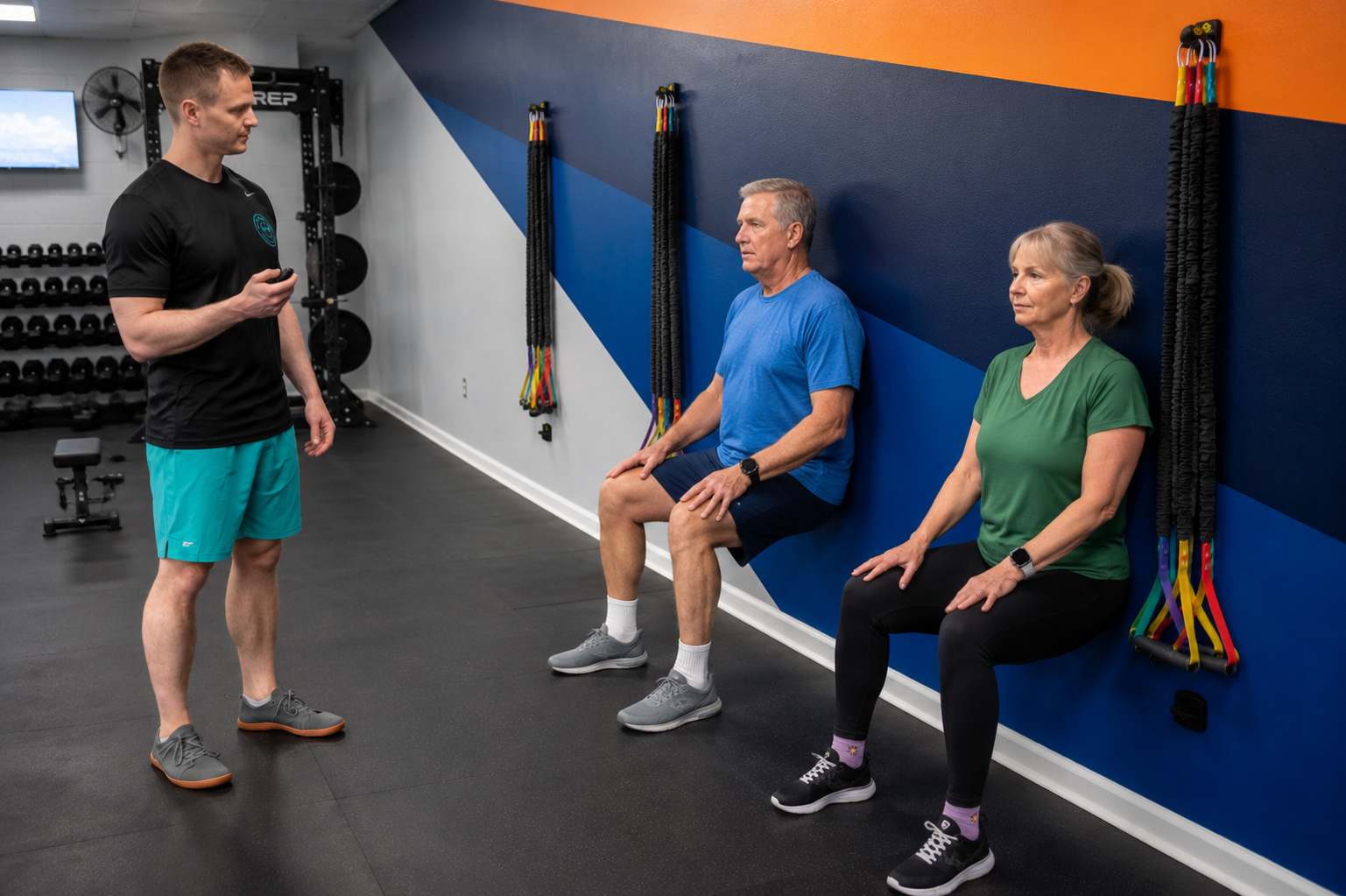
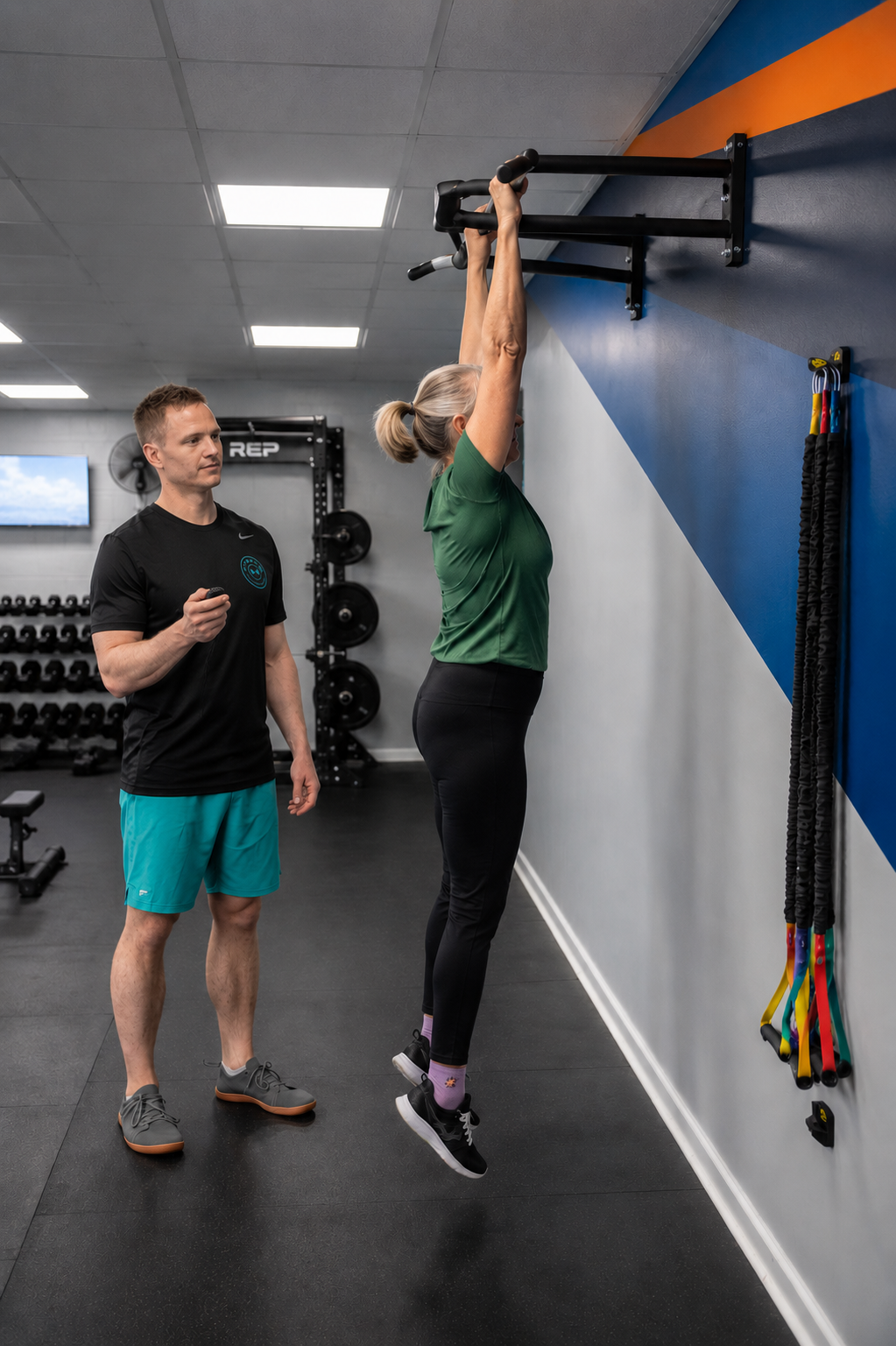
Every Fitspire member has a Functional Age Score — a single number, built from nine research-backed movement standards, that shows how your body is actually performing relative to your age. Not compared to anyone else. Compared to where you started.
Chronological age is how long you've been alive. It goes up every year no matter what you do. Functional age is how well your body is actually performing for that age — and unlike chronological age, this one you can move.
The standards cover the things that actually matter as you age: strength in your legs and grip, balance and fall prevention, core endurance, mobility, and the ability to get up off the floor under your own power. Each one is chosen because it predicts something specific about how your body holds up over the years ahead — not because it looks impressive in a gym.
How It's Tested
Tested Day One. Retested Every Quarter.
Your first Functional Age Score is taken at your Starting Point Session — coach-observed, all nine standards, no guesswork. From there, we retest every 12 weeks. Same standards, same coach, an honest comparison against where you started.
You don't have to take our word for whether the training is working. You'll see it in the number.
Real Results
What Real Retests Actually Look Like
The number only matters if it's honest. Here's what happened for five real members — and specifically what changed to get there.
Real members, real quarterly retest data. Individual results vary based on starting point, consistency, and session frequency.
Curious where you stand before committing to anything? We built a free version of this assessment you can do from home — six tests, about 30 minutes, no equipment.
Get Your Free Functional Age ScoreThe free version gives you a starting point. The real one — full nine standards, coach-observed, retested every quarter — starts with your Starting Point Session.
Book Your Starting Point SessionNot sure what to expect? See what your Starting Point Session actually involves.
Quick Links
Contact Info
Hours:
Mon-Thu: 6:00am-7pm
Fri: 6:00am-5pm
Sat: 8:00am-2pm
Sun: Closed
Follow Us


© 2026 Fitspire Personal Training. All rights reserved. | Privacy Policy | Terms of Service